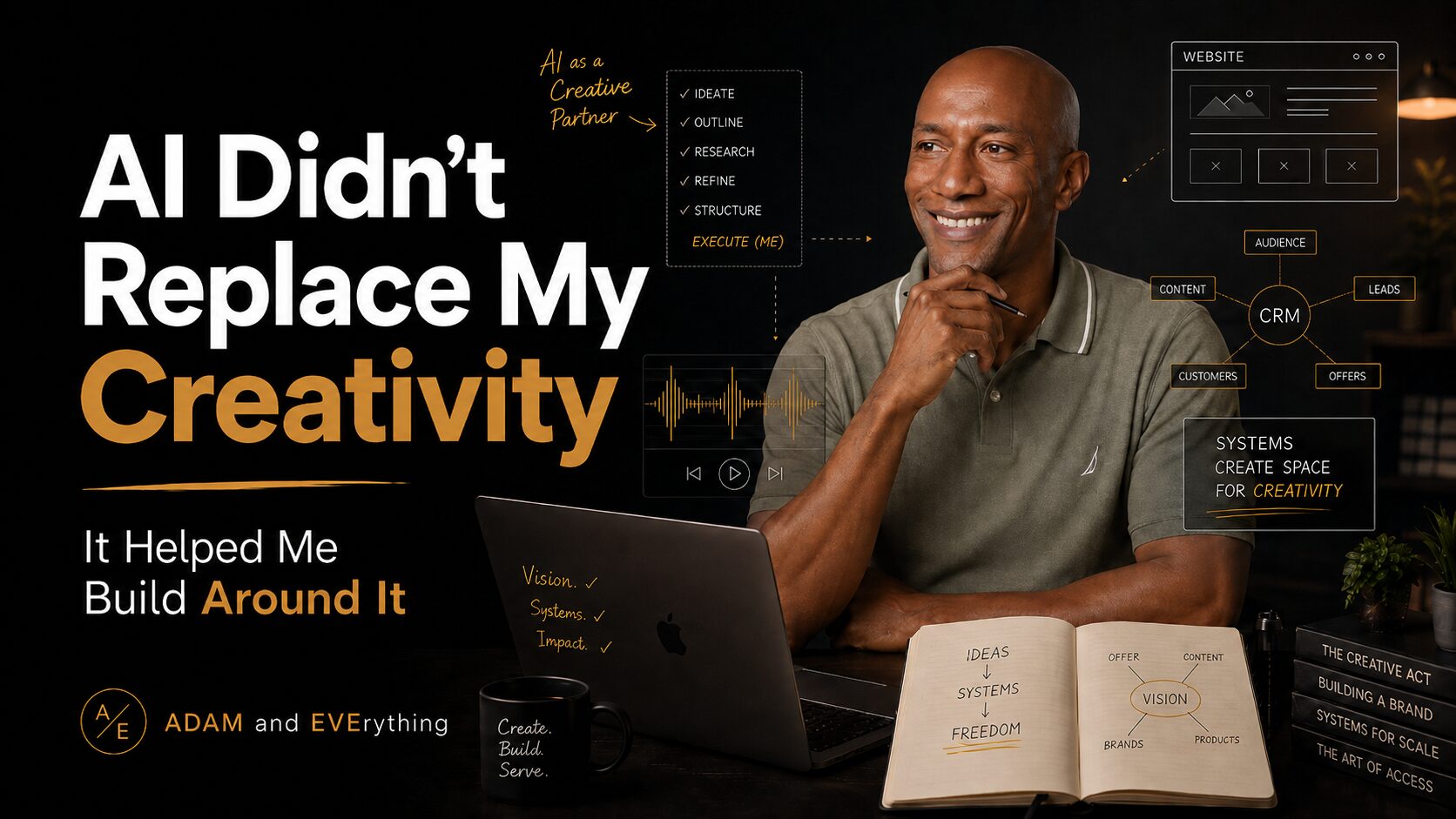
AI Didn’t Replace My Creativity. It Helped Me Build Around It.
Lately, I’ve been thinking about my own evolution with AI and creativity in general.
Not just the tools. Not just ChatGPT vs Claude, image generators, music tools, automation platforms, or the new thing that seems to drop every other week.
I mean my actual relationship with AI.
And no, not one of those AI fetish relationships. To each his own, I’m not hating, but that’s not what we’re talking about here.
How I think about it. How I use it. How I defend it. And how I respond when I see people on LinkedIn dismiss it, and the people who use it, completely.
Because lately, I’ve been running into more people who are not just skeptical of AI, but openly hostile toward it… and sometimes toward the people who use it.
Call them AI haters if you want. I understand the skepticism. What I don’t accept is the dismissal.
We should question new technology. We should ask who profits from it, who gets displaced by it, and what kind of future it’s pushing us toward. That’s fair. That’s necessary.
But there’s a difference between asking hard questions and looking down on people who use the tools available to them. And that’s where I start to have a problem.
I Wasn’t Always All In
Let me be honest first.
I didn’t always see AI the way I see it now. Early on, I had the same questions a lot of people had.
Was this replacing real creativity? Was this making people lazy? Was this going to flood the world with low-quality work and make it harder for original voices to stand out?
Some of those questions still matter.
But the more I used AI, the more I realized something: AI wasn’t replacing my thoughts. It was helping me move them.
It was helping me take ideas scattered across my mind, my notes, my conversations, my business plans, my creative concepts, my lived experience… and turn them into something more usable. Something real.
That shift didn’t happen overnight. It happened through use. Through trial and error. Through hours spent figuring out what works and what doesn’t.
And that’s the part I don’t think some of the loudest AI critics fully understand.
The Process Is Still Real
Here’s something I don’t think gets said enough: using AI doesn’t eliminate the journey. It changes it.
There’s still a process. There’s still frustration. There are still hours spent going back and forth, testing, adjusting, rebuilding, second-guessing, and pushing through. Anyone who’s worked through an AI “hallucination” — where the tool confidently gives you something completely wrong — knows exactly what I’m talking about.
And there’s a feeling when something finally works. When you’ve been grinding on a problem for hours and it clicks. When the thing you’ve been trying to build actually does what it’s supposed to do. That feeling doesn’t disappear just because AI was part of the process.
If anything, it’s part of something bigger. Every small win is just one piece of a larger picture you’re trying to build. And seeing how those pieces connect, seeing the impact start to take shape, that’s its own kind of satisfaction.
I’ve said it before and I’ll keep saying it: I use it. I don’t abuse it.
That distinction matters more than people realize.
The Privilege Piece
Now here’s where I want to be careful, because I don’t want to speak out of place or make assumptions about anyone’s life.
But I keep coming back to this.
Some people are in a position where they can afford to reject certain tools. They may have the time, the money, the education, the network, the team, the reputation, or the industry access that allows them to move without needing as much assistance.
That doesn’t mean their life is easy. It doesn’t mean they don’t struggle or work hard or have real concerns.
But there are levels to access. There are levels to opportunity. There are levels to how much support a person has around them.
So when someone with a platform casually dismisses AI users as lazy, fake, uncreative, or lesser, I think that deserves pushback.
Because not everybody has a full team.
Not everybody has an editor, a designer, a developer, a publicist, or a budget to match their vision.
Not everybody has years to wait until they can finally execute the idea that’s been sitting in their head.
For some people, AI isn’t about cutting corners.
It’s about finally having a corner to stand on.
It’s about taking an idea that used to live in a notebook or a voice memo and turning it into something real — a website, a campaign, a song concept, a business plan, a system, a story, a starting point.
That doesn’t mean the output is automatically great. It still needs taste. It still needs judgment. It still needs direction and editing and real thought.
But the person using AI isn’t automatically less creative. Sometimes they’re finally able to express the creativity that was already there.
It’s All in How You Use It
One of the biggest misconceptions I see is the idea that anyone using AI is automatically being lazy.
And yes, sometimes that’s true.
Some people type “write me a blog post about XYZ,” copy whatever comes out, paste it somewhere, and call it done. That’s not creativity. That’s not strategy. That’s not thoughtful work.
But that’s also not the only way people use AI.
Some people come to AI with the idea already formed. They have the concept. The lived experience. The point of view. The story. The frustration. The mission. The raw material.
AI doesn’t create that for them. AI helps them organize it. Strengthen it. Challenge it. Expand it. Find the gaps. Make it clearer. Turn it into something that can actually reach people.
That’s not outsourcing your brain. That’s using a tool.
And tools have always changed who gets to participate.
The Music Conversation
This is where it gets especially personal for me.
I understand why AI in music makes people uncomfortable. Music is personal. Voice is personal. Style is personal. Culture is personal. Hip-hop especially has always been tied to authenticity, lived experience, and credibility.
So when people hear “AI music,” they assume the worst. They assume someone typed a prompt, generated a track, and now wants to be treated like an artist.
And sometimes, maybe that’s exactly what happened.
But that’s not the only version of the story.
I’ve experimented with AI music personas (DJ Calm Down / Warren Stuffett ), and yes, someone on LinkedIn decided that was worth dismissing. Not just the tool, but the creative vision, the concept, the character, the story behind it. As if the idea itself didn’t matter because AI was involved.
But here’s the thing: there’s a difference between an AI-assisted creative project built around a concept and vision, and what I’m currently doing with edogmusic.com, a new platform for legendary Boston rap artist Edo G.
Edo G. is the real thing. His voice is his voice. His face is his face. His legacy is his legacy. His music is his music. His name carries weight because of what he has actually done over decades in this culture. He’s among few to be recognized as an honoree in the Nationational Hip-Hop Museum in DC.
AI doesn’t create that.
But AI can help me build around it.
AI helps with the platform. The CRM infrastructure. The content strategy. The fan journey. The revenue systems running behind the scenes. AI helps me organize the digital infrastructure so the attention he already has can be captured, nurtured, and converted into something sustainable, a real revenue engine with a central source of truth for his fan base.
That’s not replacing the artist. That’s supporting the artist.
That’s helping someone with real talent finally have the systems they should have had around them years ago.
Two different use cases. Both valid. Both intentional. Both built with a clear vision behind them.
AI Can Be Abused. So Can Everything Else.
None of this means AI is harmless.
AI can flood the internet with generic content. It can imitate without respect. It can be used to avoid learning. It can make mediocre work look polished enough to pass. It can threaten livelihoods. It can flatten originality.
Those concerns are real.
To be clear: I’m not defending using AI to steal someone’s voice, copy someone’s style, fake someone’s likeness, or pass off generated work as lived experience. That deserves criticism. There should be standards. There should be boundaries. But those concerns should not erase every thoughtful, intentional, and ethical use of the technology.
A camera can be used lazily. A beat machine can be used lazily. A ghostwriter can be used lazily. A marketing agency can be used lazily.
The issue isn’t only the tool.
The issue is the intention, the execution, the ethics, and the person behind it.
AI doesn’t automatically make something soulless. People make soulless things with or without AI.
Where I Stand
I’m not here to worship AI. I’m not telling everyone they need to use it for everything. I’m not pretending there are no risks or that every concern is overblown.
But I’m also not going to pretend AI hasn’t helped me.
It has helped me think more clearly. Execute faster. Organize bigger ideas. Support creative projects. Build systems that would have been much harder to build alone.
And that matters.
For me, AI isn’t about avoiding the work. It’s about making more of the work possible. It’s about taking the ideas, stories, strategies, and creative visions that already exist and giving them more ways to become real.
In five years, some people may say we weren’t using AI nearly enough. Others may say we let it go too far. Both are possible. But pretending it’s going away isn’t a serious position.
The real divide isn’t going to be between “AI users” and “real creatives.”
It’s going to be between people who use tools with intention — and people who use tools without it.
That has always been the divide.
AI just made it more visible.
This is part of what ADAM and EVErything is really about: the intersection of creativity, business, culture, technology, and the systems that shape who gets to build. If this resonates, explore more in the EVErything section or see the revenue systems work I’m building through MASH — Marketing And Sales Help.