Vibe Coding Websites: I Built One With AI. Here’s Why That Was the Easy Part.
Vibe Coding Websites And Apps Has Arrived
Collins Dictionary named “vibe coding” its word of the year in 2025. And honestly? That make sense. The barrier to building something that looks professional has basically collapsed. Give a decent AI tool a decent prompt, iterate for a few hours, and you can have a functioning, polished website or app that would have taken weeks (and go for an absurd amount of money) not long ago.
I know this because I’ve been doing it.
The new Marketing And Sales Help website, MarketingAndSalesHelp.com, was built using what I call AI SaaS Building. And I built it without writing code in the traditional sense. I designed it through conversation, iteration, and systems thinking aka effective prompting coupled with legit EEAT.
That caught my own attention, honestly. Not because the technology is new. It isn’t. But because of what it reveals about where the real advantage lives now.
A quick note on starting over.
I want to be transparent about something. This rebuild meant migrating away from WordPress, which means we lost the blog content and organic traffic we had been building there. All of it. The indexed pages, the keyword rankings, the momentum. Gone.
That’s a real cost, and I don’t want to gloss over it. Starting fresh on a new platform means rebuilding our search presence from the ground up. But I made the decision intentionally. The capabilities I needed for where MASH is heading, the interactivity, the integrated backend, the ability to build custom tools and experiences directly into the site, required a foundation WordPress wasn’t going to give me. Sometimes you have to trade short-term momentum for long-term infrastructure. That doesn’t make the reset painless, but it makes it worth it.
At least, I believe it’ll be worth it. While I still love wordpress and use it for the majority of my websites, they haven’t been able to adapt or evolve with the times. I think it’s fair to assume that vibe coding is only going to get bigger.
Edward Sturm said something that stuck with me.
In a recent video, Edward Sturm, who’s been posting daily SEO content for over 1000 consecutive days on his youtube channel Edward Show, made a point that I think most people building with AI tools right now are going to learn the hard way. I’m paraphrasing, but the core idea that he mentioned is this: there’s a ton of noise around flashy tactics that seem cool but ultimately lead people astray. Most vibe coding apps and sites will look great or at worse, professional. However, most of them will lack the visibility infrastructure to actually be found and displayed by ChatGPT, Google, and other LLMs.
That’s not a criticism of vibe coding. That’s a criticism of mistaking the container for the system.
A website isn’t a destination. It’s an instrument.
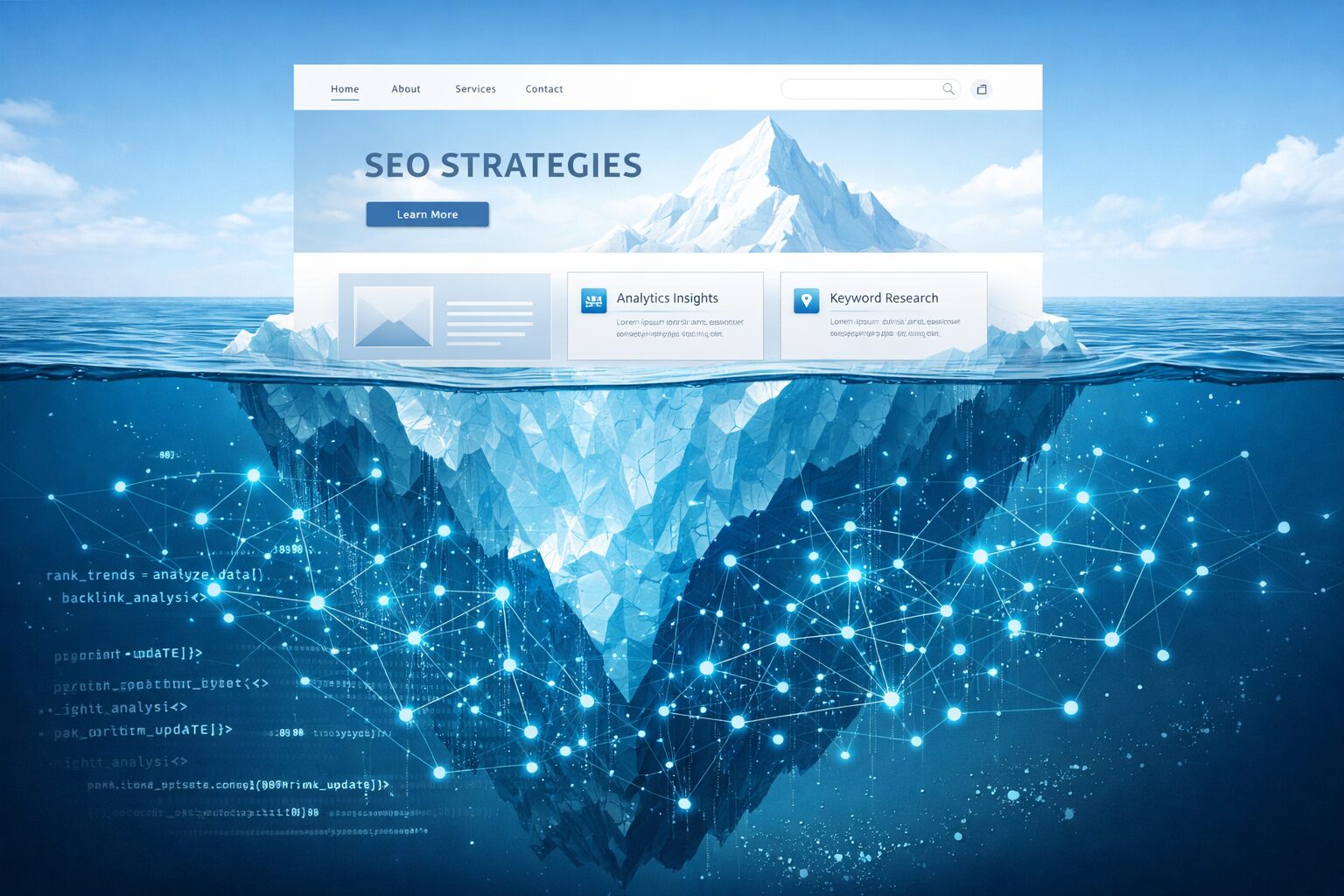
Here’s where I think the gap is widening. When I built the MASH site, the design and user experience were important, but they were maybe 40% of the thinking. The other 60% was about what happens after someone arrives, and more importantly, how they find it in the first place.
Some of what went into that invisible layer: dynamic SEO metadata that updates across every page, structured data for search engines and AI models, SEO-friendly routing with canonical URLs and redirects to prevent duplicate content, and content specifically structured for both traditional search crawlers and the LLMs that increasingly shape how people discover businesses through AI overviews. Dedicated case study pages and an insights section designed to build topical authority over time.
None of that is flashy. All of it matters. Especially when you’re rebuilding your presence from zero. Not to say the site doesn’t look great too, it does – but there is more to it than meets the eye.

The system behind the surface.
This is what I keep coming back to when I think about AI tools and business building: the tools have democratized creation, but they haven’t democratized strategy. Anyone can stand up a beautiful site in an afternoon. But understanding why you’d place specific content above the fold or how to structure your site so that it builds authority signals from the way it explains itself… that’s a different skill set entirely.
And it’s the skillset that separates a site that exists from a site that works.
I built this site partly as a business tool and partly as a proof of concept. If I’m going to help other businesses with marketing and sales, my own platform should demonstrate the thinking I bring to client work. The tech stack, the SEO architecture, the content strategy, the lead generation infrastructure, it’s all one system. The site isn’t just a brochure. It’s an engine. And right now, it’s an engine in its earliest miles, earning trust with search engines and AI models one page at a time.
What’s next, and what I haven’t even touched yet.
Here’s the part that genuinely excites me. The site is live, but the real work is shifting now to content creation, to finishing internal projects like MY MASH CARD or DJ CALM DOWN, and to client work. The site was the foundation. The content is the fuel. And after resetting our search presence, the content strategy matters more than ever.
And the tooling keeps evolving. I haven’t even started working with MCP integrations or exploring agentic frameworks. I’ve been using TaskMagic for automation, building with AI generation tools that use node-based branching mechanisms, visual workflows that feel more like designing systems than writing instructions. It’s not only powerful. It’s fun. And I don’t say that lightly about work tools.
This is a genuinely exciting time to be in this space. When everybody can build without effort, the value of building decreases, and I think that’s right. Which means the value shifts upstream, to the people who understand why something should be built a certain way, not just how to make it appear.
The question I keep thinking about regarding vibe coding websites and apps:
As AI tools keep lowering the floor on what it takes to create, what happens to the businesses that only optimize for appearance? And what does it look like when the businesses that optimize for systems, for visibility, for discoverability, for genuine authority, start compounding their advantage?
I don’t think we’ve seen the full shape of that gap yet. But I think it’s coming fast.
If you’re a business in the greater Boston area, or anywhere really, and you’re thinking about how to make your online presence actually work for you (not just look good), that’s exactly what we do at MASH. Let’s talk. Head to MarketingAndSalesHelp.com or reach out directly. I’d love to hear what you’re building.