When Good People Defend Bad Systems: Introducing Normacism
Normacism Framework Definition
The Normacism framework is a diagnostic lens for identifying when systems, rules, or institutional norms are treated as neutral and unquestionable, even when they consistently produce unequal or harmful outcomes. It focuses on how unexamined baselines become protected from scrutiny across social, political, and organizational systems.
Most people assume injustice is driven by bad intentions.
I don’t.
By trade, I build systems. Sales funnels. CRMs. Revenue operations. When a system consistently produces bad results, we don’t blame the users, we audit the design. We ask where friction is hiding, what filters are misfiring, and which assumptions were baked in without being questioned.
So over the past year or two, watching public debates unfold, I stopped asking “Why are people racist?” and started asking a different question:
Why do good people protect systems that cause harm, simply because those systems feel normal to them?
That question led me to develop a framework I call Normacism, now formalized as the Normacism Framework.
What Is Normacism? Understanding the Normacism Framework
Normacism describes a recurring reasoning pattern where people treat existing systems, rules, or outcomes as neutral and unquestionable, even when those systems consistently produce unequal or harmful results.
It’s not about hatred.
It’s not about intent.
It’s not about morality.
It’s about what happens when protecting “how things work” becomes more important than examining what those systems actually do.
Normacism shows up when we:
- Defend procedures because they’re familiar, not because they’re fair
- Focus on whether rules were followed instead of whether people were helped or harmed
- Treat unequal outcomes as inevitable, deserved, or “just the way it is”
- Shift responsibility onto individuals while insulating systems from scrutiny
Most people who engage in normacist reasoning sincerely believe they’re being objective.
That’s what makes it powerful.
The Normacism Framework Loop
How the Normacism Framework Works
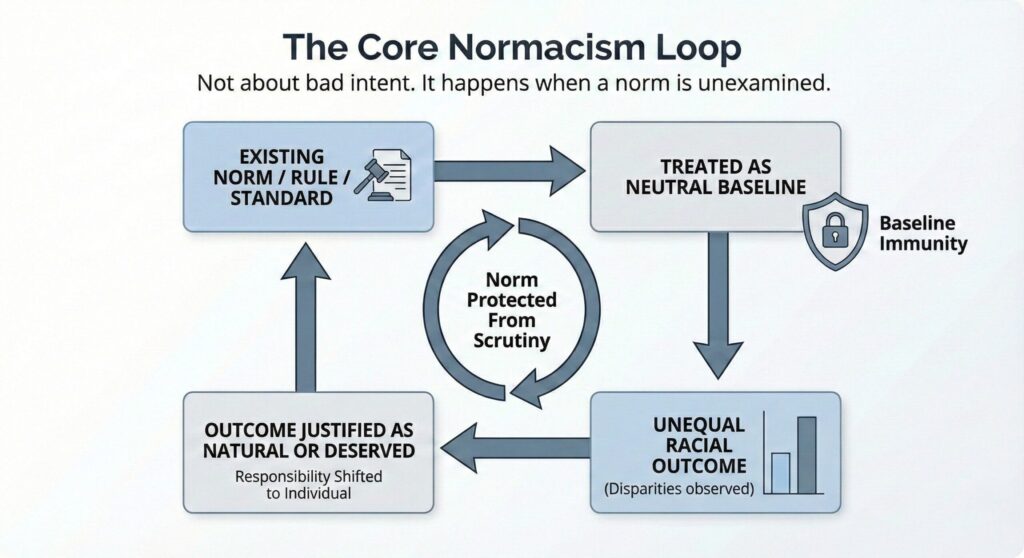
Framework developed by Adam Ace Spencer
Normacism occurs when unequal outcomes trigger defense of the norm instead of examination of the system that produced them.
This loop explains how unexamined standards become insulated from scrutiny, allowing unequal outcomes to persist without overt intent. The Normacism Framework uses this loop to help identify when systems are being defended instead of evaluated.
The loop is disrupted when norms are re-examined instead of defended.
Why I Built This Framework
My background is in Sales, RevOps, and Marketing. I’ve worked inside systems like Salesforce to HubSpot, and now I build custom CRM tools using AI.
In business, if a funnel rejects qualified buyers, we don’t say:
“Those leads just weren’t serious.”
We say:
“Something in the system is misconfigured.”
So when I looked at the broader social and political landscape in 2025, I didn’t see “evil people.” I saw a broken operating system that everyone was treating as normal.
My academic background is primarily in Rhetoric and Film, with extensive coursework in Anthropology and Africana Studies at Bates College. That training wired me to pay close attention to how language, norms, and institutions quietly shape outcomes. Normacism, and the Normacism Framework, is simply the diagnostic label for a pattern I kept seeing across different domains.
What Normacism Sounds Like
Normacism often hides inside statements that sound reasonable on the surface:
- “That’s just how the system works.”
- “The process was fair.”
- “We treat everyone the same.”
- “The data doesn’t lie.”
- “People need to follow the rules.”
None of these statements are inherently malicious.
But they all share a common move: they defend the baseline instead of examining it.
Everyday Examples
Hiring
A company says, “We just hire the best candidate.”
But “best” consistently looks the same, and no one examines how qualifications were defined or filtered.
Education
A school enforces a policy equally, then points to unequal discipline outcomes and says, “We applied the rules fairly.”
The rule itself is never questioned.
Business
A sales system prioritizes corporate emails and titles. When real buyers get filtered out, the response is:
“Serious customers look more professional.”
In each case, the system is treated as neutral, and the outcome is defended because the rules were followed.
That’s normacism.
Why Politics Made This Pattern Impossible to Ignore
For many people, this reasoning pattern became especially visible over the past year in political contexts.
Rather than getting stuck in the usual debates, I kept hearing the same defense:
- “They’re following the law.”
- “That’s how it’s always been.”
- “The process is neutral.”
The harm wasn’t being defended directly.
The normalcy of the process was.
That’s when I realized I needed a word, not to accuse people, but to name the pattern.
Is Normacism About One Party, Race, or Type of Person?
No.
I’ve seen normacist reasoning across race, class, and political ideology.
I’ve watched Black professionals defend government and corporate policies that hurt other Black people because “that’s just how capitalism works.”
I’ve heard calls for “law and order” framed as neutral necessity without examining who bears the cost.
Normacism isn’t about who you are.
It’s about what you defend, and whether familiarity overrides scrutiny.
That said, race often reveals normacism most clearly, because racial inequality has been historically encoded into laws, policies, and institutions that later get defended as “neutral” once their origins fade from view.
What Normacism Is… and Isn’t
Normacism is not:
- A way to call people racist without saying the word
- An accusation of personal hatred or moral failure
- A denial of effort, merit, or responsibility
- It is not a rebranding of racism or an academic theory with no practical use.
The concept is informed by existing research on system justification and colorblind racism. It focuses specifically on how unexamined norms function operationally across systems.
Normacism is:
- A way to identify when systems are being protected from examination
- A tool for shifting conversations from intent to design
- A framework for asking better questions about outcomes
If someone discriminates directly because of race, that’s racism.
Normacism is what happens when people say “the system is fair” without checking whether that’s actually true.
How the Normacism Framework Is Meant to Be Used
The Normacism Framework is not meant to replace existing theories or debates. It is designed as a practical diagnostic tool for examining systems before conclusions are drawn about fairness, merit, or intent. Its purpose is to shift conversations from intent to design, and from comfort to clarity.
How to Recognize Normacism in Real Time
When someone defends a policy, system, or outcome, ask:
- Are they defending the result, or the rules?
- Do they resist examining history or system design?
- Do they treat change as more dangerous than harm?
- Do they prioritize comfort with “normal” over concern for impact?
If the answer keeps circling back to “that’s just how it works,” you’re likely seeing normacism at work.
Why This Matters Now
The most persistent injustices today aren’t loud or obvious.
They’re procedural.
They hide behind neutrality.
They survive because they feel familiar.
Normacism names that mechanism.
The Normacism Framework gives language and structure to something many people sense but struggle to explain.
Not to shame people, but to give us a way to examine systems honestly, even when doing so feels uncomfortable.
What’s Next
Over the coming weeks, I’ll be applying the Normacism framework to:
- Hiring debates and “pipeline problems”
- AI systems that inherit biased baselines
- Education and discipline policies
- Economic and immigration policies framed as neutral
The goal isn’t to win arguments.
It’s to help us see patterns clearly enough to design better systems than the ones we inherited.
If this made you uncomfortable, that’s okay. I catch myself defending “normal” too.
The question Normacism invites isn’t “Who’s wrong?”
It’s:
“What are we protecting… and why?”
Learn More
Normacism.com launches January 20, 2026.
There you’ll find:
- A plain-language guide
- Real-world examples
- Tools for productive conversations
- A growing FAQ and resource library
If you want updates as this framework evolves, you can join the list here.
I’m genuinely anxious and curious to see how this lands with folks… agreement, disagreement, or pushback.
Comment below or DM me on LinkedIn.
Author Bio
Adam Ace Spencer is a creative growth consultant, digital builder, and entrepreneur based in Massachusetts. He runs Marketing & Sales Help (MASH), helping businesses generate awareness, diagnose broken funnels, and align systems for revenue growth. A Bates College graduate with a background in Rhetoric and Film and extensive study in Anthropology and Africana Studies, Adam applies the same diagnostic logic he uses in business to understanding how “neutral” systems produce unequal outcomes.
For the Normacism Project: Normacism.com
For Business Help: MarketingAndSalesHelp.com





2 Comments